Working with a company gives students an opportunity to see how their research and design decisions respond to needs beyond the classroom. For a team from the first AISS cohort, this experience took shape through CRITERION, an Interdisciplinary Project developed in collaboration with Coresbond.
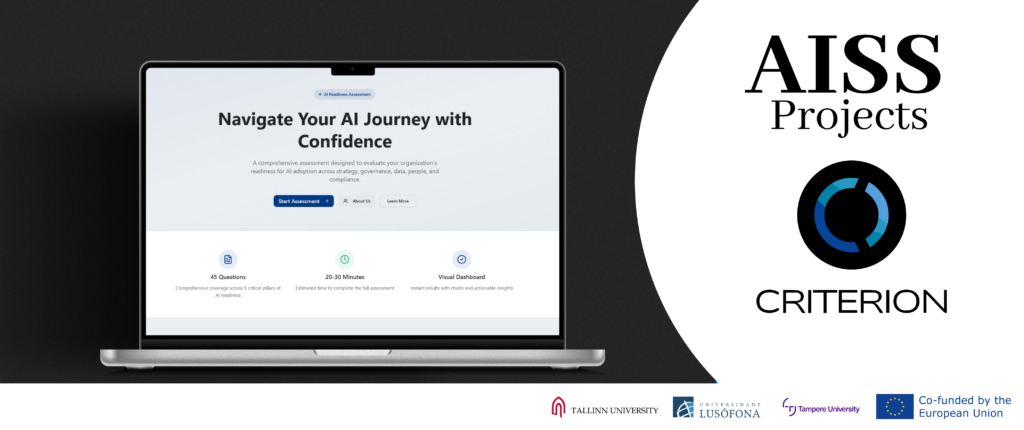
Venus Schwidrowski, Myrnelle Cinco, Kevin De Lange, Deniz Yener and Ligia Anjos developed a prototype to help small and medium-sized businesses assess their readiness to adopt AI. Presented as an AI Readiness Compass, the tool brings organisational preparedness and questions about responsible AI use into a structured assessment.
Defining a project with an industry partner
Coresbond is a Finnish company working on development projects for the technology industry. Discussions with the company helped the students define a concrete purpose for their work: an assessment that Coresbond could use with its clients to explore their starting point for AI adoption.
Defining this brief was part of the learning process. The team needed to consider what information would be useful to a business and how to communicate it to people who might have limited experience with AI.
The collaboration connected academic research with a professional context, giving the students a reason to examine the practical usefulness of their design choices.
Translating research into an assessment
The team drew on research into organisational AI readiness and examined governance and regulatory considerations. They translated these ideas into assessment questions covering areas such as business strategy, data foundations, workforce capabilities and responsible AI practices.
The intention was to help businesses identify gaps and consider priorities for further development. This required attention to both the assessment content and the experience of completing it.
Developing the interactive prototype brought these concerns together. The students worked on question wording and scoring alongside the interface and the presentation of results.
Learning from professional feedback
The team gathered feedback from four reviewers with experience across industry and academia. Their responses provided concrete direction for improving the prototype.
Some questions were difficult to interpret or score. Others assumed organisational processes that smaller businesses might not have. Reviewers also wanted clearer guidance on what a business could do after receiving its results.
The students used this feedback to refine the assessment. They separated questions that combined several concepts, made the wording more accessible and improved the recommendations accompanying the results.
This stage made the value of iteration visible: an assessment grounded in research also needs to make sense to the people expected to use it.
An example of interdisciplinary learning at AISS
CRITERION gave the team an opportunity to connect research with interface design and technical implementation while responding to an external partner’s needs.
The project illustrates what the Interdisciplinary Project course can involve: developing a concrete proposal, presenting it to professionals and using their feedback to improve the work. It also highlights the importance of considering organisational needs and responsible use when exploring AI adoption.